From Jihad to Instagram: The Taliban’s New Playbook

In 2025, American porn star Whitney Wright visited Afghanistan, where she posed for glamour shots with Taliban fighters, held an AK-47, and toured Band-e Amir National Park. She documented her travels on Instagram, sharing glimpses of Kabul and Herat, including historic architecture, bustling streets, and colorful markets.
One small detail Wright omitted from her glowing portrayal of Taliban-ruled Afghanistan: Afghan women had been banned from visiting Band-e Amir since 2023.
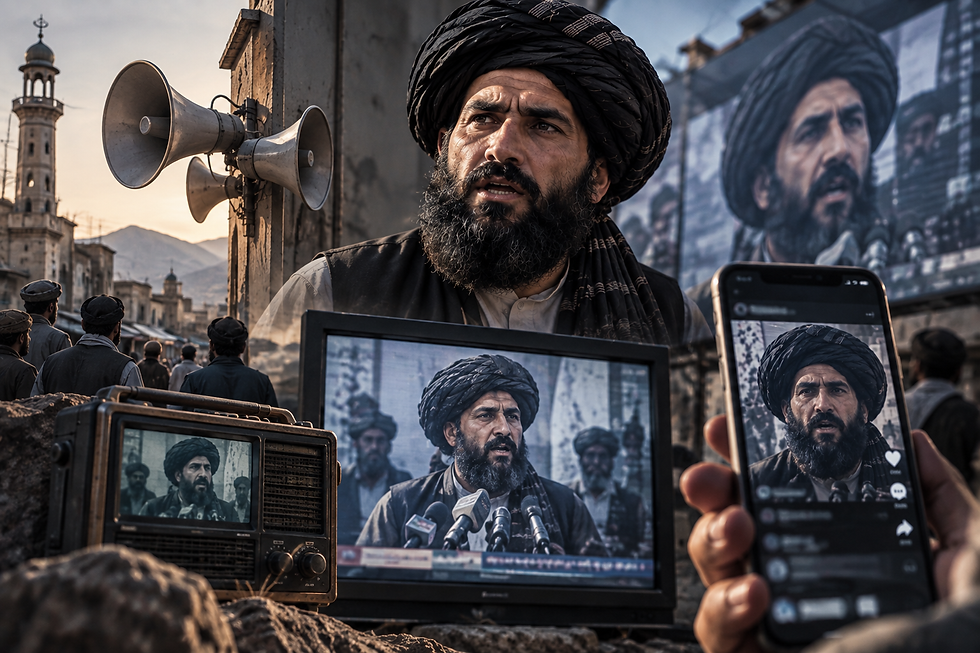
Beyond the obvious double standard, Wright’s visit offers a glimpse into the Taliban’s evolving information warfare strategy. Five years after returning to power, the movement is working to reshape its image abroad, using Western influencers, carefully curated tourism, and social media to cultivate international legitimacy. At home, the Taliban maintains tight control over information and education, shaping the narratives and beliefs of a new generation of Afghans.

The contradictions read like something out of an absurd political satire. In another widely publicized visit, openly gay British tourist Toyosi Osideinde described a romantic encounter with a Taliban security guard in an Afghan hotel. By contrast, LGBTQ Afghans who would dare to flaunt a same-sex relationship so openly face imprisonment, public flogging, and even death.
Chasing social media clicks and viral moments, foreign visitors enjoy freedoms denied to Afghan citizens, then return home praising Taliban hospitality and tolerance. Meanwhile, Afghan women remain excluded from education and much of public life, and independent journalists risk detention for challenging the regime’s narrative.
The tragic irony is that those whose stories deserve to be heard most are the least free to tell them.
The Taliban’s ambitions, however go beyond rehabilitating its international reputation. The movement is adapting the information warfare strategies that helped it undermine the U.S.-backed Afghan government during America’s 20-year war, this time to consolidate its rule and extend its ideological influence beyond Afghanistan.
For the United States, these developments should raise serious national security concerns. After all, what happens when the Taliban, with its longstanding ties to extremist organizations, gains international credibility while spreading an ideology that could inspire future acts of terrorism?
The battlefield has changed. The competition over the narrative continues.
From Resistance to Governance
During the insurgency, the Taliban portrayed itself as Afghanistan’s legitimate resistance against foreign occupation and a corrupt government. Following the U.S. withdrawal, it faced a new challenge: demonstrating its ability to govern while seeking investment and international recognition amid Western sanctions and diplomatic isolation.
Majeed Qarar, a former cultural attaché at Afghanistan’s embassy in Washington and strategic communications adviser, said Taliban propaganda now emphasizes security, infrastructure, and economic development.
“They are mostly using development stories for political propaganda,” he explained, pointing to ambitious investment promises that have yet to materialize.
Dr. Haroon Hakimi, Afghanistan’s former deputy minister of information and culture, highlighted the heavily promoted Qosh Tepa Canal and videos portraying Taliban fighters as courteous toward civilians. The movement also celebrates the American withdrawal through social media, traditional taranas (religious chants), and theatrical reenactments.
“They perceive the U.S. withdrawal as a great military victory,” Hakimi explained. “For them, it shows that their jihad was successful and that their Islamic beliefs were right. They continue to celebrate this victory through taranas, social media, and public performances, presenting themselves as the ones who freed Afghanistan.”

At the same time, the Taliban’s pursuit of international legitimacy has hardly softened its anti-Western messaging. According to Qarar, the movement continues to tell followers that “the West is still the enemy” and that they are “still fighting the world, but in a different way.”
Western sanctions, he explained, are portrayed as another form of foreign aggression. Meaning, the Taliban presents itself as liberator and capable government, while casting hardship as another chapter in its struggle against the West.
Different Messages for Different Audiences
The moderate image of Taliban rule promoted by Western visitors is only part of the strategy. Qarar has developed what he calls the three-D model to explain the movement’s objectives: deception, delusion and direction.
The first, deception, targets ordinary Afghans. Through official media, religious figures and local networks, the Taliban selectively contrasts its rule with the former republic, exaggerating improvements in security and making ambitious promises of economic development.
The second, delusion, targets international audiences and Afghan nationalists, including the diaspora. Qarar argues these activities create confusion about Taliban intentions, buying time to consolidate its power.
“They are trying to give us this delusion that Taliban are changing,” Qarar said, describing the impression that the movement is becoming more peaceful, pragmatic, and nationalist.
He pointed to the Taliban’s tensions with Pakistan as one example. By portraying itself as a defender of Afghan sovereignty, the movement can appeal to nationalists who might otherwise reject its Islamist ideology. Qarar argues that this image masks a more ambitious objective: promoting a radical movement that challenges Western influence and the existing international order.
The third, direction, targets the Taliban’s own followers. Here, Qarar distinguishes between public propaganda and internal ideological education. Through religious schools, WhatsApp groups, and Telegram channels, the movement promotes a militant Islamist worldview centered on opposition to Western political and cultural influence.
These different messages can reinforce one another. While foreign visitors promote Afghanistan as a peaceful destination and Taliban representatives seek economic cooperation, internal networks portray Western values as a threat to Islamic society.
Qarar also alleges that the movement cultivates sympathetic voices within the Afghan diaspora, sometimes through promises of influence or intimidation. Such intermediaries can promote an image of moderation and foster international engagement more credibly than Taliban officials themselves.

Meanwhile inside Afghanistan, the Taliban’s control over official media means independent journalists face censorship and intimidation, preventing realistic accounts of life under the regime from reaching international audiences.
Indoctrinating the Next Generation
While the Taliban tailors its propaganda to different audiences, one of its most consequential efforts aims to shape the beliefs of Afghanistan’s next generation.
Since returning to power, the movement has expanded its control over religious education while barring girls from secondary schools and universities. Qarar argues that Taliban-directed madrasas are central to its long-term effort to cultivate a generation loyal to its ideology.
A September 2026 ODI Global report, based on interviews with students, parents, and teachers in Kabul, warns that the Taliban is using religious schools to promote its strict interpretation of Islam and normalize extremist beliefs.
The concern is not religious education itself, but its use for political indoctrination. Qarar argues that the regime’s internal instruction increasingly promotes a transnational Islamist identity and opposition to the Western-led international order, even as its public messaging emphasizes stability and economic development.
Hakimi raised another concern: the potential reach of Taliban ideology beyond Afghanistan. He described accounts of Taliban-associated individuals providing online religious instruction to children in Afghan diaspora communities in Europe and the United States, sometimes incorporating anti-Western messages.
Unlike a social media campaign designed to influence public opinion in the short term, ideological education can shape beliefs and loyalties for generations. The United States has reason to be concerned that the Taliban is raising a generation steeped in an ideology hostile to the West, with potential consequences for regional stability and American national security.
The Taliban’s Digital Information War
The Taliban’s online information campaign extends far beyond official government accounts. According to Hakimi, networks of supporters amplify its messaging across X, Facebook, and TikTok. They promote sympathetic personalities and target critics with insults, accusations of being anti-Islamic, and attacks involving personal information. Their goal is to silence dissent.
Qarar similarly describes efforts to cultivate supporters in the West through promises of influence, financial incentives and, in some cases, intimidation. He also alleged that the Taliban pays influencers abroad to promote its interests and has long benefited from sympathetic voices within American media and Afghan diaspora communities across the West.
“I would say the most effective propaganda machine of the Taliban that affects Afghans and the international community is run from the West,” Qarar said. “It’s more effective if someone else speaks on your behalf.”
The Taliban also exerts influence over content produced inside Afghanistan but consumed abroad. A 2024 Washington Post investigation documented how authorities granted favorable YouTube creators access to government ministries and activities while using broadcasting licenses and other restrictions to influence coverage. With successful creators earning advertising revenue from large audiences abroad, favorable coverage can benefit both the creators and the Taliban.
Adding insult to injury, foreign tourists and social media influencers visiting Afghanistan showcase attractive destinations rather than the hardships facing ordinary Afghans. Simply put, in an effort to gain exposure through favorable impressions, their content reinforces the Taliban’s preferred narrative while appearing to offer independent testimony.
For the United States, the concern is not simply the reach of Taliban propaganda, but that sympathetic voices operating within American society are shaping perceptions of a regime whose ideological objectives and relationships with extremist networks remain consequential to U.S. national security.
THE THREAT BEYOND AFGHANISTAN’S BORDER
For many Americans, Afghanistan has become a closed chapter. After two decades of war, the 2021 withdrawal ended a costly military commitment, and Washington's attention shifted toward China, Russia, Iran and other security challenges.
But America’s departure did not eliminate the threats emerging from Afghanistan today.
United Nations sanctions-monitoring reports continue to identify terrorist organizations operating in Afghanistan, including al-Qaeda, Tehrik-e-Taliban Pakistan (TTP), and ISIS-K. Their continued presence raises serious questions about the Taliban’s relationships with extremist groups and its willingness or ability to prevent Afghan territory from threatening other countries.
As the Taliban promotes an image of hospitality and effective governance, it also seeks greater diplomatic recognition, economic cooperation, and international legitimacy. The danger is that such favorable perceptions could encourage engagement without sufficient scrutiny of extremist networks or the ideology shaping its institutions.
At its core, the Taliban’s agenda is not local. Even as its international messaging portrays the regime as a pragmatic government seeking peaceful relations with the outside world, its jihadist ideology envisions an Islamic order extending beyond Afghanistan’s borders, with serious implications for regional and international security.
For American military and intelligence professionals, distinguishing between these competing narratives is essential. It requires sustained attention to the Taliban’s local-language communications, religious discourse, educational institutions, and digital networks, as well as independent Afghan voices capable of challenging official accounts.
The United States spent two decades confronting an insurgency that exploited American cultural misunderstandings and failures of governance to undermine a militarily superior adversary. Today, the Taliban employs many of those same information warfare principles to legitimize its rule, develop support abroad, and shape the ideological posture of a new generation.
None of this demands a return to large-scale military intervention. But it does demand continued vigilance. As the Taliban seeks greater international acceptance, American policymakers must not confuse a more polished public image with a fundamental change in the movement’s intentions.
America may have left Afghanistan. But the Taliban’s information war continues, and the United States remains one of its targets.
* * *
About Jessica L. Walton: Jessica is a communications strategist and writer in the defense industry based in the Washington, D.C. area. She is also a writing instructor for professionals in government, national security, technology, and engineering through the "Maximizing Impact" workshop. A former IDF soldier and security analyst, she specializes in information operations and asymmetric warfare.
To request the workshop for your organization or to receive regular blog pieces to your inbox, check out the contact page here.


Comments